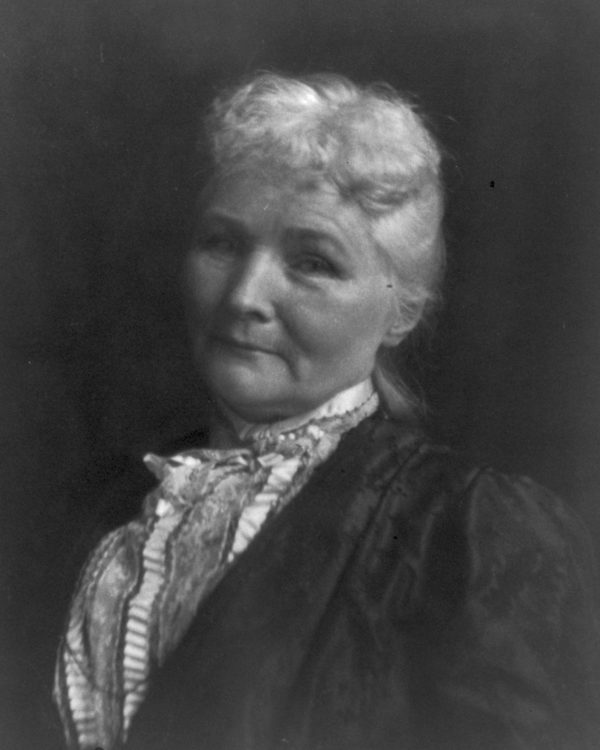
Cork, Toronto, Memphis, Chicago
Mary Harris was baptized in Cork, Ireland, on August 1, 1837. She later gave her birth year as 1830 and her birthday as May 1, and in 1930 she celebrated a hundredth birthday. Her family left Ireland in the famine years and settled in Toronto, where she trained as a teacher. She taught at a convent school in Monroe, Michigan, then moved to Memphis, where in 1861 she married an iron molder and union man. In the yellow fever epidemic of 1867 her husband and their four children died. She went to Chicago and opened a dressmaking shop, which burned in the fire of October 1871.
By 1897 she was working for the United Mine Workers in the strike in the Pittsburgh district, and the miners were calling her Mother Jones.
The anthracite fields
In the anthracite strike of 1900 she organized the miners' wives. On September 22, 1900, she led about five hundred women carrying brooms from McAdoo to the Coleraine colliery near Beaver Meadow. In early October, according to the Philadelphia Times, a march on Lattimer drew four to five thousand miners and women.
When the 1902 strike began she was in West Virginia, trying to bring out the soft-coal miners. On June 20 she was arrested near Clarksburg for defying a federal judge's injunction and taken to Parkersburg. The judge, John Jay Jackson Jr., let her go and jailed the organizers arrested with her. In July, John Mitchell telegraphed her to come to the union's special convention on the anthracite strike at Indianapolis, where she spoke on July 19. In September she wrote that she had gone “directly from Ohio to the anthracite” to report to Mitchell. In October she spoke in Massachusetts to raise money for the strikers. On November 8, a week before the commission's hearings opened, she wrote to Mitchell from Montgomery, West Virginia, and signed the letter “Mother.”
Mitchell, and after
She turned on Mitchell later. In 1903 he agreed to a settlement in the northern Colorado coal field while the southern miners stayed out, and she never forgave him. In her Autobiography (1925) she wrote that flattery had led him to accept arbitration in 1902, and she summed up the settlement in one line: “Labor walked into the House of Victory through the back door.”
In July 1903 she led the March of the Mill Children, striking textile workers and their children, from Kensington in Philadelphia to Roosevelt's summer home at Oyster Bay, where his secretary turned them away. She was arrested in the West Virginia strike of 1912–13 and tried by a military commission, and she was held in Colorado in 1914 during the strike that ended at Ludlow. She died at Silver Spring, Maryland, on November 30, 1930, and was buried in the Union Miners Cemetery at Mount Olive, Illinois.
“Pray for the dead and fight like hell for the living!”Autobiography of Mother Jones, 1925