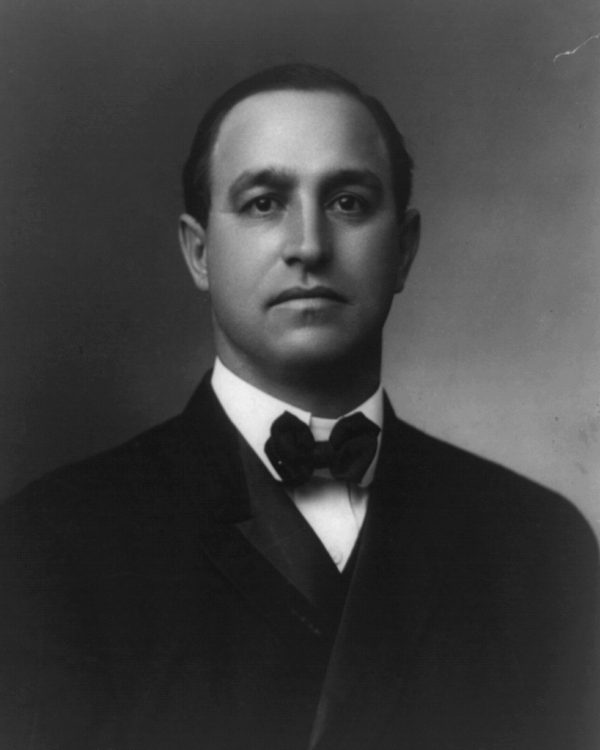
Braidwood
John Mitchell was born in Braidwood, Illinois, on February 4, 1870, the son of Robert Mitchell and Martha Halley. His mother died when he was about two. His father, a Civil War veteran, was killed a few years later; his biographer Elsie Glück says by a runaway team. He was raised by his father's third wife, who took in washing, and he went to school when he could. At ten, when his stepmother married again, he left home and hired out to a farmer as a water boy for a dollar a week.
At twelve he went back to Braidwood and started working in the mines, although Illinois law set the minimum age at thirteen. He worked up to mule driver and then miner. He joined the Knights of Labor at fifteen, worked in the mines of Colorado and New Mexico, and settled in Spring Valley, Illinois, where he married Katherine O'Rourke, a miner's daughter. When the United Mine Workers of America was founded in 1890, he was one of the first in his district to join.
President at twenty-eight
He rose fast: sub-district secretary-treasurer in 1896, national organizer in 1897, national vice-president in January 1898. When the president, Michael Ratchford, resigned later that year, Mitchell took his place, and in January 1899 he was elected in his own right. He was twenty-eight. The union's headquarters were in Indianapolis. His wife and children stayed in Spring Valley, and he saw them two or three times a year.
In September 1900 he led the anthracite miners out, and six weeks later they went back with a ten percent raise. The miners made October 29, the day the strike ended, a holiday and named it Mitchell Day.
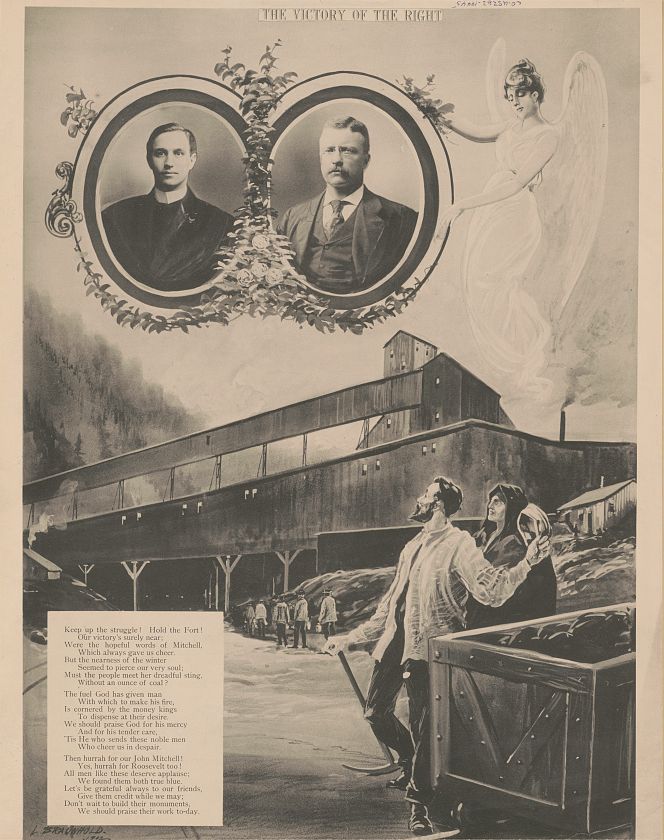
1902
In May 1902 the operators turned down his offer to arbitrate, and on May 12 the anthracite miners stopped work. About 147,000 men were out. Mitchell kept the strike orderly and worked to keep public opinion on the miners' side. In July, at a special convention in Indianapolis, he argued against calling out the soft-coal miners in sympathy, and won. “As far as my knowledge goes,” he said, “I do not know of one solitary sympathetic strike of any magnitude which has been successful.” The convention raised a relief fund instead.
On October 3, at the temporary White House, he offered to send the men back to work if the President named a tribunal, and said the miners would accept its decision “even if it is against their claims.” The operators refused. Roosevelt wrote later that Mitchell “kept his temper admirably and showed to much advantage.” At Mitchell's urging, Roosevelt put a Catholic bishop, John L. Spalding, on the commission. The miners went back to work on October 23.
Mitchell was the first witness when the hearings opened in Scranton on November 14, and he was on the stand for four days. The award of March 1903 gave a ten percent raise, a nine-hour day for company men and a board of conciliation. It did not recognize the union, though Mitchell argued that it did so in practice by treating the union as one of the parties. In his book Organized Labor, published that year, he defended the decision to arbitrate.
“As we had struggled for the principle of arbitration, we would not be justified in refusing to accept it because victory was within our hands.”John Mitchell, Organized Labor, 1903
Afterward
He dressed less like a miner than a clergyman, in a long coat buttoned up to a straight collar, and immigrant miners took him for a priest. He was not a Catholic in 1902; he became one later in life.
He gave up the presidency in April 1908, citing his health, and took a salaried post with the National Civic Federation, which brought employers and union leaders together. In 1911 the union voted that its members could not belong to the Federation, and he resigned from it. He served on New York's Workmen's Compensation Commission and then chaired the state's Industrial Commission. He died of pneumonia in New York on September 9, 1919, after a gallstone operation. Father John J. Curran celebrated his funeral Mass in Scranton, where he is buried. He left about $250,000, most of it in stocks and bonds.