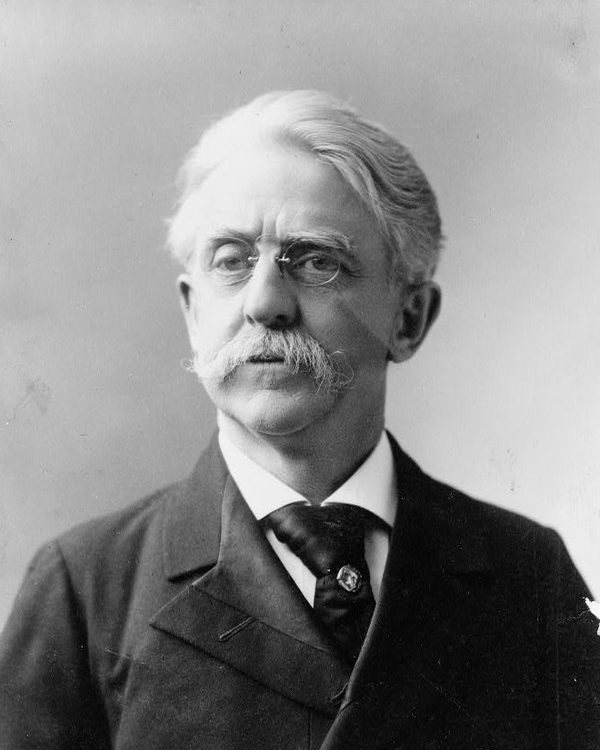
The Tribune and the monopolies
Henry Demarest Lloyd was born in New York City on May 1, 1847. He studied at Columbia and was admitted to the New York bar in 1869. From 1872 to 1885 he wrote editorials for the Chicago Tribune. In 1873 he married Jessie Bross, the daughter of one of the paper's owners, and in 1878 the couple took over The Wayside, an old inn at Winnetka, north of Chicago, which was their home from then on.
In March 1881 the Atlantic Monthly published his “The Story of a Great Monopoly,” an attack on the Standard Oil Company that was as much about the railroads that gave it secret rebates. “The railroads create the monopoly,” he wrote, “and then make the monopoly their excuse.” His book Wealth Against Commonwealth (1894) made the case at length. Its second chapter, “Cut Off from Fire,” is about the anthracite railroads and their freight rates.
With the miners
In 1887 Lloyd went to Springfield to ask Governor Richard Oglesby to spare the men condemned after the Haymarket bombing, against the wishes of the Tribune's editor, Joseph Medill. His book A Strike of Millionaires Against Miners (1890) told the story of the lockout at Spring Valley, Illinois, where John Mitchell was then working. During the Pullman strike of 1894 he advised the railway union to hire Clarence Darrow.
In 1902 he ran relief for the striking anthracite miners. In October, Mitchell named him and the economist Walter Weyl as his representatives before the commission, and Lloyd was the first to raise the case with Darrow. On December 15, 1902, he tried to put twenty years of evidence about the coal railroads before the commission, to show that the companies hid their mining profits in the freight charges of their railroads. After about an hour and a half the commission stopped him. “We are going to assume that the operators are able to pay fair wages,” said the chairman, Judge George Gray.
On February 9, 1903, in Philadelphia, Lloyd gave his closing argument, on recognition of the union and a permanent trade agreement. George Baer, replying, called him a “philanthropist from Chicago.” Mitchell said afterward that Lloyd would take no payment for any of it: “No; not one penny.”
“It is to be hoped that the strike of last summer was the Waterloo of capitalistic absolutism in this country.”Argument before the commission, February 9, 1903
Lloyd caught pneumonia while campaigning for city ownership of Chicago's street railways, and died in Chicago on September 28, 1903. About four thousand people came to his memorial meeting at the Chicago Auditorium, where Mitchell and Darrow spoke. Darrow said of him: “Henry D. Lloyd was rich, but uncorrupted by wealth.”