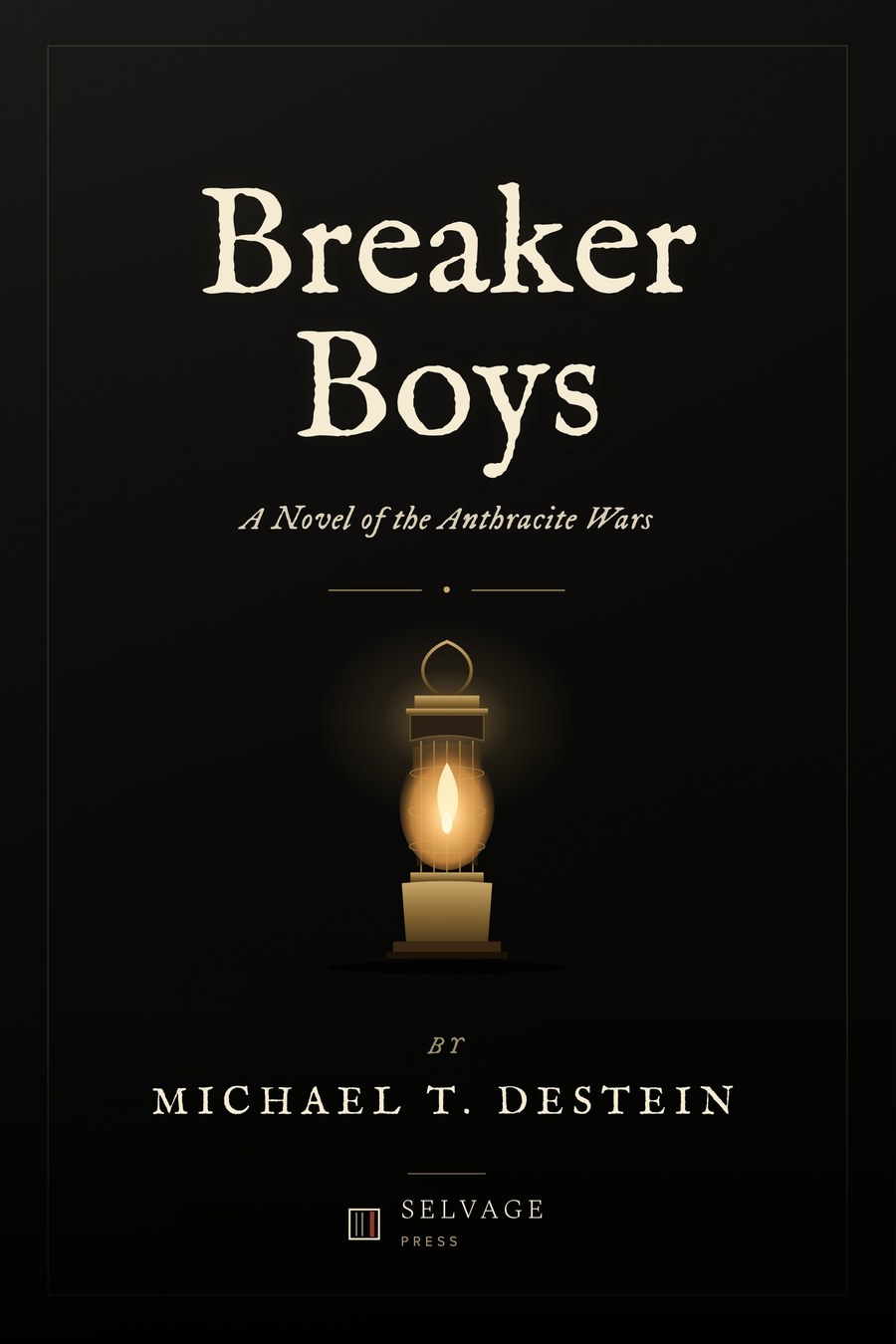
Literary historical fiction · Pennsylvania, 1902
A Novel of the Anthracite Wars
For readers of Fall of Giants and Ragtime
In May 1902, a hundred and forty-seven thousand men and boys walked out of Pennsylvania's hard-coal mines and shut off the heat to a nation. They stayed out a hundred and sixty-three days. This is the novel of that winter — and of the children who were the argument nobody could answer.
Built inside the historical record, with a closing note that accounts for every place it departs from it.
Kindle $7.99 · free with Kindle Unlimited · Paperback $22.00
| Particulars | EarningsCredit | DeductionsDebit | ||
|---|---|---|---|---|
| Coal, 39 cars @ 1.15 | 44 | 85 | ||
| Yardage, 12 ft. | 1 | 35 | ||
| Rent of house | 4 | 00 | ||
| Powder | 9 | 75 | ||
| Oil and squibs | 2 | 40 | ||
| Sharpening of tools | 1 | 80 | ||
| Store account | 27 | 63 | ||
| Doctor and hospital | 1 | 00 | ||
| Totals | 46 | 20 | 46 | 58 |
Under the Breaker · No. III
The Bobtail
Of all the documents the coal region produces, the most instructive is the one the miners call a bobtail check — a check, that is, with nothing upon the end of it. It is the statement a man receives upon pay-day in the place of his wages, and it merits the attention of any citizen who supposes that to labor is, in this country, of necessity to be paid. — E. M. Carroll, from the novel
Running through the book is a series of dispatches from the coal country, published in 1902 over the initials E. M. Carroll: twelve cool, unsparing sketches of the breaker, the company store, the boys, the women, the private police. Who wrote them is one of the quiet turns of the novel.
A book about what reasonableness wins, what it costs, and who pays the bill.
Four o'clock in the morning and the Worek house breathes in the dark. Stanislaw goes down the shaft and comes up owing the company money. His son Pawel is thirteen and will not go into the mine if his father has to work every hour left to him to prevent it. Three doors along, Tomasz Kowalski is eleven and told the company he was twelve.
Four hundred miles west, John Mitchell — thirty-two, president of the United Mine Workers, who went into the Braidwood breaker at twelve and now wears a high collar and works to be mistaken for a banker — is about to ask a hundred and fifty thousand men to starve on purpose, and to do it quietly enough that the country stays on their side.
Against him stands George F. Baer, who believes God gave the coal to the men who own it and puts it in writing. At his back is J. P. Morgan. Behind Mitchell there is nothing but the patches: six-and-twenty nations at the bottom of a single shaft who will not sit at one another's tables, a company store that owns the flour and the rent and the coffin, and a winter coming on.
Breaker Boys runs from a boy on his knees in the black snow of Braidwood, Illinois, in 1882 to Clarence Darrow's closing argument at Scranton twenty-one years later — by way of the first hour in American history when a president sat a union man down at the same table as the men who owned the fuel.
Take your child by the hand, and lead him up the breaker stairs.Clarence Darrow, closing for the United Mine Workers
Anthracite Coal Strike Commission · 13 February 1903 · from the transcript
The record it is built on
What's true, and where the novelChild labor was never one of the strike's formal demands. It became the moral center of the case anyway — at the hearings, where Darrow made the breaker boys the thing the operators could not answer, and where the testimony fed a national child-labor movement for a decade after. The book is built inside that record and closes with a note accounting for every place it departs from it.
The breaker boys: a history, with Lewis Hine's photographs →
Read the prologue and Chapter One in one scroll →
Prologue
The Bellevue-Stratford Hotel, Philadelphia — Autumn 1918
In the autumn of 1918, John Mitchell was walking through the corridor of the Bellevue-Stratford Hotel in Philadelphia when the smell stopped him. It was nothing: a spent carbide lamp on a service cart outside a meeting room, the ghost of its extinguished flame still hanging in the air like the memory of something that had happened in another century. He stopped walking. The men with him continued another three steps before they noticed. They turned. He was standing with his hand on the wall, not because he needed support but because the wall was there, and the smell was doing something to him he could not account for and could not explain to men who had never sat alone in total darkness for ten hours with nothing for company but the sound of their own breathing and the distant, muffled intelligence of the earth.
“Mitchell?” Elgin said.
He looked up. “Forgive me,” he said. “I thought I smelled something.”
He had. He just could not say what.
Buy the book
Selvage PressThe complete novel — prologue, thirty-one chapters, epilogue, and the twelve Under the Breaker sketches.
Kindle · $7.99 Paperback · $22.00
The Kindle edition is free to read with Kindle Unlimited. No audiobook yet.
Not today? Mark it Want to Read on Goodreads, or hear about the next book.
| Title | Breaker Boys: A Novel of the Anthracite Wars |
| Author | Michael T. Destein |
| Publisher | Selvage Press, 2026 |
| Formats | Kindle ebook Paperback, 5.5 × 8.5 in |
| Price | Kindle $7.99, or free with Kindle Unlimited Paperback $22.00 |
| Audiobook | Not yet |
| Length | Approx. 95,000 words 378 pages in paperback |
| ISBN | 979-8194870417 (paperback) |
| Category | Fiction / Historical / 20th Century · Fiction / Political |
The book was built to be argued about. Five places to start:
One email when the next novel is out, and occasional notes from the research. Nothing else, and you can leave at any time.
Already read it? An honest review on Amazon or Goodreads does more for a book like this one than any advertisement. It is how the next reader finds it.