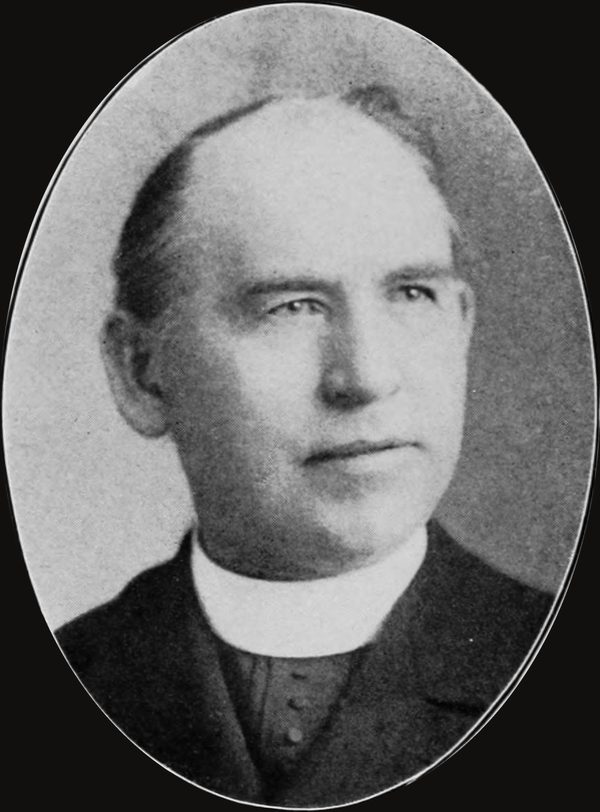
From the breaker to the priesthood
John Joseph Curran was born in Wayne County, Pennsylvania, on June 20, 1859, to John and Helen Curran. His father had come from Ireland and worked as a miner. According to a 1930 history of Wilkes-Barre, the family moved to Avoca, in Luzerne County, when he was about seven, and at eight he went to work as a slate picker at the Pennsylvania Coal Company's Avoca mines. He later drove mules. He studied at night school, then at Wyoming Seminary, at St. Vincent College in Latrobe and at the Grand Seminary in Montreal, and he was ordained at Scranton in 1887. In 1895 he became the first pastor of Holy Saviour parish, in the East End of Wilkes-Barre.
He did not begin as a friend of the union. Elsie Glück, who interviewed him for her 1929 biography of John Mitchell, wrote that he had been “hitherto antagonistic to the union” until Mitchell won him over.
1902
In July 1902 Curran tried to settle the strike on his own. On July 14 he spent more than two hours with George Baer in Philadelphia, and two days later he met a leading coal man in New York. Then he gave up, saying the operators would make no concessions. In August he wrote to the Catholic Telegraph: “There is no doubt whatever of the oppressed condition of the poor mine workers of our districts.”
In early October he was in New York again, seeing “men identified with the coal interests.” On October 2, the day before the White House conference, he said the struggle must end “not on terms of dishonorable and ignoble capitulation by either side, but on terms of honorable compromise.” He spoke at the Wilkes-Barre convention that ended the strike on October 21 and called it the happiest day of his life. On December 5 and 6 he testified before the commission in Scranton, where he disputed the operators' reports of widespread violence and said the troops sent to the coal fields had not been needed.
Roosevelt's friend
“The man in Wilkes-Barre who helped me most was Father Curran … throughout my term in office, and afterward, he was not only my stanch friend, but one of the men by whose advice and counsel I profited most.”Theodore Roosevelt, An Autobiography, 1913
Curran went to Washington to see the President in June 1903. Roosevelt came to Wilkes-Barre in 1905 for a temperance rally at which Curran and Cardinal Gibbons spoke, toured the mining towns with Curran and Mitchell in 1910, and in August 1912 stayed at Curran's house for the celebration of his twenty-fifth year as a priest.
Around 1918 Curran moved to St. Mary's parish in Wilkes-Barre. He celebrated John Mitchell's funeral Mass in Scranton in September 1919. By the 1930s he was a monsignor, and he was still mediating in the coal fields: in November 1934, during a fight between rival miners' unions, dynamite was found under his rectory. He died in Wilkes-Barre on November 7, 1936, at seventy-seven.