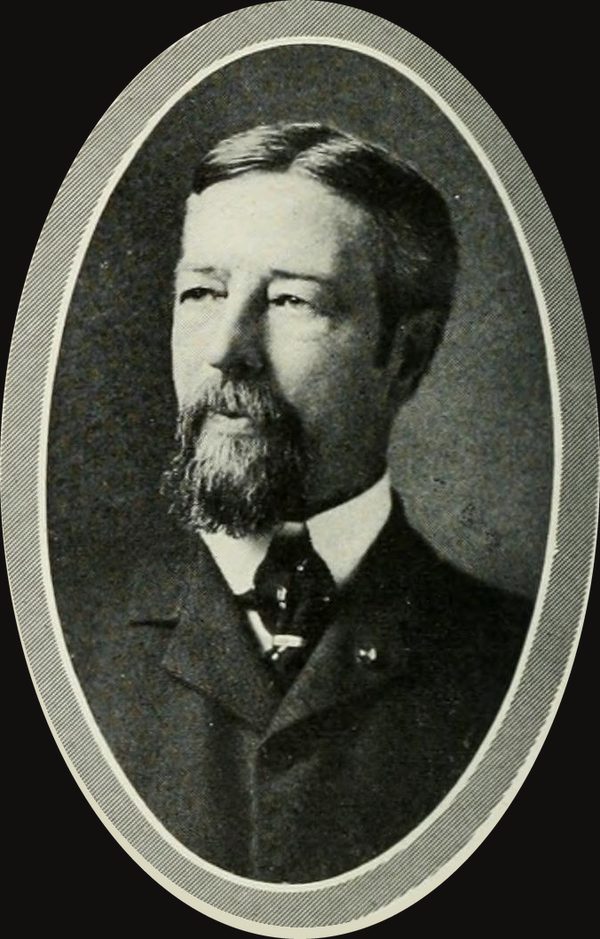
Printer, captain, lawyer
George Frederick Baer was born in Somerset County, Pennsylvania, in 1842, the son of Solomon and Anna Baer. The sources disagree on the day: an 1886 county history and his trade-press obituary give September 26, the New York Times April 13. He learned printing in the office of the Somerset Democrat, spent a year at Franklin & Marshall College, and in 1861 bought the paper with his brother Harry. In August 1862 he raised a company for the 133rd Pennsylvania Volunteers, a nine-month regiment, and was its captain at Antietam, Fredericksburg and Chancellorsville.
He was admitted to the bar in 1864 and moved to Reading in 1868. Within a few years he was counsel to the Philadelphia and Reading Railroad, and for many years he was J. P. Morgan's legal representative in eastern Pennsylvania. On April 3, 1901, he was made president of the Reading companies. In 1902 he signed as president of the Philadelphia and Reading Coal and Iron Company, the Lehigh and Wilkesbarre Coal Company and the Temple Iron Company.
The letter
In May 1902 John Mitchell proposed that the miners' demands go to arbitration. Baer refused on May 9: “Anthracite mining is a business, and not a religious, sentimental, or academic proposition.” The strike began three days later.
In July a Wilkes-Barre photographer, W. F. Clark, wrote to him about the strike. Baer answered on July 17 with a short typed letter on the railroad's letterhead.
“The rights and interests of the laboring man will be protected and cared for — not by the labor agitators, but by the Christian men to whom God in His infinite wisdom has given the control of the property interests of the country, and upon the successful Management of which so much depends.”George F. Baer to W. F. Clark, July 17, 1902
The Associated Press sent it out from Wilkes-Barre, and it appeared in newspapers on August 20. The New York Times said it “verged very close upon unconscious blasphemy.” On Labor Day, Mitchell spoke of “ownership by divine right,” and the papers began calling its author “Divine Right” Baer.
At the White House and before the commission
On October 3, 1902, the operators and the union leaders met Theodore Roosevelt at the temporary White House. Baer read a written statement. He refused Mitchell's offer to send the men back to work under an arbitrated settlement, said Mitchell had “no right to come from Illinois to dictate terms,” and asked the President to restore order “at any cost.” Ten days later, after Morgan intervened, the operators agreed to a presidential commission on their own terms, and Baer's name headed their signatures.
Baer gave the operators' closing argument before the commission in Philadelphia on February 12, 1903. He spoke for two hours and twenty minutes, mostly reading from a manuscript. “We concede to organized labor the same rights that we claim for organized capital,” he said. He proposed a sliding scale that would tie wages to the price of coal, and the commission's award adopted one. He dismissed Henry Demarest Lloyd as a “philanthropist from Chicago.”
He was still at work in 1914. On the morning of April 25 he was taken ill while walking to his office in the Reading Terminal, and he died at his home on Spruce Street in Philadelphia the next evening.