A society built on missions, ranchos, and Native resistance.
Before there was a Bear Flag Republic, there was a California made by Indigenous people and reorganized by colonizers. The Spanish mission system, established along the coast beginning in 1769, sought to convert Native people, concentrate them near missions, and extract their labor. Baptism did not make the relationship equal: mission authorities controlled movement, work, food, family life, and punishment. Native people resisted by leaving, refusing, sabotaging, attacking, preserving ceremony, and building lives beyond the missions.
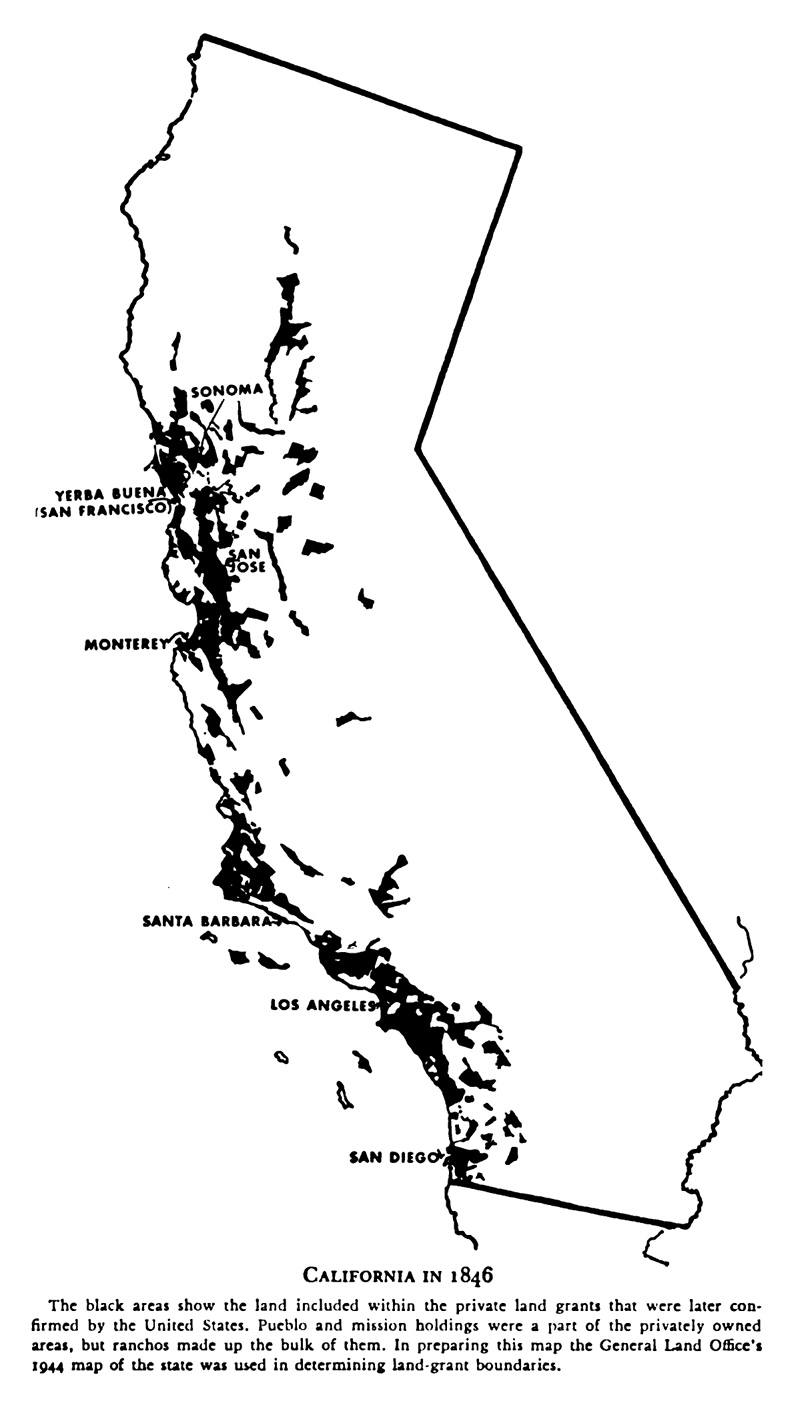
After Mexican independence in 1821, the new government secularized the missions. Secularization was presented as liberation and redistribution, but the promised land and political power rarely reached Native communities. Mission property, cattle, and labor networks were broken apart or transferred to private grantees. The result was the rancho economy remembered in romantic paintings: cattle wealth for a small Californio elite, precarious work for many others, and continuing dispossession for Indigenous people.
Californios were not a single, harmonious class. They included families of mixed Indigenous, Spanish, African, and other ancestry, soldiers, officeholders, rancheros, artisans, and laborers. Elite families used marriage, kinship, cattle, and local office to build influence, while Mexican officials in distant Mexico City struggled to supply troops or enforce policy. The church remained culturally powerful even after the missions were secularized, but political authority had moved toward the civil government and private ranchos.
Church and state
The missions were religious institutions and engines of colonial administration. Priests baptized and recorded Native people; soldiers enforced the frontier; civil officials distributed land. Their boundaries were never as tidy as later stories suggest.
Work and wealth
Hide-and-tallow exports tied California to global markets. Vaqueros, domestic workers, artisans, sailors, and Native laborers made the rancho system function, while land titles and political connections concentrated its rewards.
Native California
“The Indians” is a colonial shortcut for hundreds of nations and communities. Some people entered missions, some moved between worlds, and some refused mission control altogether. Their political choices matter even when the archive reduces them to labor counts.
Culture in motion
Languages, foodways, horse culture, Catholic ritual, Indigenous ceremony, Mexican law, and Pacific trade met in daily life. California was a borderland before it was a state, and borders did not stop people from crossing them.
02 · Social history before the republic
Culture, labor, landand belonging
A society built on missions, ranchos, and Native resistance.
Before there was a Bear Flag Republic, there was a California made by Indigenous people and reorganized by colonizers. The Spanish mission system, established along the coast beginning in 1769, sought to convert Native people, concentrate them near missions, and extract their labor. Baptism did not make the relationship equal: mission authorities controlled movement, work, food, family life, and punishment. Native people resisted by leaving, refusing, sabotaging, attacking, preserving ceremony, and building lives beyond the missions.
After Mexican independence in 1821, the new government secularized the missions. Secularization was presented as liberation and redistribution, but the promised land and political power rarely reached Native communities. Mission property, cattle, and labor networks were broken apart or transferred to private grantees. The result was the rancho economy remembered in romantic paintings: cattle wealth for a small Californio elite, precarious work for many others, and continuing dispossession for Indigenous people.
Californios were not a single, harmonious class. They included families of mixed Indigenous, Spanish, African, and other ancestry, soldiers, officeholders, rancheros, artisans, and laborers. Elite families used marriage, kinship, cattle, and local office to build influence, while Mexican officials in distant Mexico City struggled to supply troops or enforce policy. The church remained culturally powerful even after the missions were secularized, but political authority had moved toward the civil government and private ranchos.
Church and state
The missions were religious institutions and engines of colonial administration. Priests baptized and recorded Native people; soldiers enforced the frontier; civil officials distributed land. Their boundaries were never as tidy as later stories suggest.
Work and wealth
Hide-and-tallow exports tied California to global markets. Vaqueros, domestic workers, artisans, sailors, and Native laborers made the rancho system function, while land titles and political connections concentrated its rewards.
Native California
“The Indians” is a colonial shortcut for hundreds of nations and communities. Some people entered missions, some moved between worlds, and some refused mission control altogether. Their political choices matter even when the archive reduces them to labor counts.
Culture in motion
Languages, foodways, horse culture, Catholic ritual, Indigenous ceremony, Mexican law, and Pacific trade met in daily life. California was a borderland before it was a state, and borders did not stop people from crossing them.
A parallel, with limits
It is tempting to compare the U.S. newcomers of the 1840s with modern unauthorized migrants. The comparison is useful only if the power difference stays visible. Many U.S. settlers entered Mexican territory without Mexican permission, formed communities, demanded local political control, and eventually used military power to make their presence sovereign. That resembles modern arguments about irregular migration only at the level of people crossing a border and contesting authority. The legal systems, racial categories, technologies, and consequences are different. The sharper question is older: when newcomers call their settlement inevitable, who gets asked to consent?